7 Bookkeeping Myths that Cost Small Businesses Money
- Angel Dams
- Oct 24, 2025
- 6 min read
This is just a scratch off the surface to what the term "bookkeeping" really means, and how it applies to any entrepreneur, but whether you have 12 transactions a month or 1200, regular bookkeeping is important. Here are just a few, of the many, perceptions business owners initially have about bookkeeping, until they jump on board and experience the benefits for themselves.
Myth 1: Bookkeeping really only needs to be done once per year.
Dare we say it........2 full months left in 2025. Only two. Time flies by. Do not wait until January, or April, to decide you need help organizing your business. It is tough to find quality bookkeeping availability in slow times, and especially once tax time hits. It causes high stress, when it could have been lessened, or even totally avoided.

Take time to make calls, ask questions and find a bookkeeper you feel comfortable with. A solid bookkeeper becomes a regular part of your business. Stay on top of things on a regular basis - as in monthly. Tax time is not the only benefit to monthly bookkeeping - being able to have a clear picture of what is actually coming in and going out each month and learning how to assess your success is a huge pro.
Myth 2: Positive Bank Balance means Positive Cash Flow + State of Business
Cash in the bank does not mean your business is turning profit, or keeping afloat.

So many things come into play:
Have you reconciled your accounts? Not just the bank, but all loan + tax accounts as well
What do your accounts payable + receivable picture look like? Knowing your cash flow is a real thing.
Have you set enough aside for tax filing?
Do you make installments to your sales tax accounts?
There are many things that impact the true picture.
Myth 3: Annual CRA business remittances need to make only one payment per year.
"The CRA". 9/10 business owners have stress flags flying when this is the topic of a conversation. It really does not need to be stressful.
Even if you are an annual GST filer, if your NET GST payment will be $3000, or more, then CRA expectations are quarterly instalments.
If you expect to owe more than $3,000 in federal corporate taxes for the year. The instalment payment schedule depends on the corporation's tax liability from the previous year. If a corporation owes $3,000 or more in federal corporate tax, it must make monthly installments, which are due on the last day of every month. Smaller-based companies with less than $500K revenue, may qualify for quarterly instalments. If the corporation owes less than $3,000 in the prior year, no installments are needed, and the full payment is due by the tax filing deadline.

TIP: Get in the habit to make monthly payments. Take your GST collected, deduct your income tax credits and send in some cash. This keeps you from having to pay one large lump sum at the end of the year, and it takes away any chance of being dinged with fees + interest. A positive cash flow tactic.
With regular reconciliations + support, you can easily pull a number to track when you meet thresholds for taxes, see amounts quickly that should be made, ease stress.
Myth 4: My accountant is a bookkeeper; My bookkeeper is my accountant.

Bookkeepers are day-to-day financial organizers, with the goal to keep financial data current, accurate + organized, so that you, as a business owner, know your business standings at any time. Full Cycle Bookkeepers record all income and expenses, reconcile accounts, not just bank but liabilities, taxes, etc. They will track your government remittances and deadlines for you, and correspond directly with your accountant, the CRA + any organizations on your behalf that you need. Their work makes monthly reports (P&L, Balance, cashflow) readily available with ease. Be mindful tip: Bookkeeping is a learned trade, and is beyond an admin/data entry position. Basic bookkeeping generally does not provide the experience or full year end reconciliations and reviews as what is considered Full-Cycle Bookkeeping.
Accountants are financial interpreters & strategists, with the goal to use bookkeeper's data to analyze, interpret, and report on the overall financial health of the business. With accountants, you will see that they use the bookkeeping data to file taxes, do year-end adjustments and handle compliance (If you are not getting year-end adjustments as a corporation, look into that!). They can often provide financial analysis and planning, and advice on minimizing taxes, business structure + long term strategy. Be mindful tip: Not all tax preparers are accountants, and are not trained or knowledgeable in tax savings, corporate adjustments, etc. - In our professional opinion, we strongly suggest educated CPA's for any incorporated business.
They work together: The bookkeeper builds the foundation — accurate records. The accountant builds on that foundation — interpreting and filing reports to CRA or investors. If the books aren’t clean, the accountant’s work becomes slower, costlier, and sometimes inaccurate.
Myth 5: Bookkeeping is just applicable for larger businesses
Every business, no matter the size, benefits from accurate bookkeeping. Even sole proprietors and side hustlers need accurate records to understand cash flow, claim deductions, and plan ahead. Without proper bookkeeping, small expenses go untracked, and business owners often overpay taxes or miss valuable financial insights.
It’s actually one of the best ways to save money — fewer penalties, lower accountant bills, and smarter financial decisions. Even sole proprietors and small businesses benefit—clean books mean fewer tax surprises and smarter decisions.
Contract bookkeeping saves money vs. hiring in-house and prevents costly mistakes or missed deductions.

Here's how the investment pays off:
Catching errors early saves you from CRA penalties.
When your books are accurate and up to date, mistakes like missed GST filings, unrecorded income, or duplicate expenses are caught before they become costly.
You only pay for the time you need.
Hiring a contract bookkeeper (like your business) is far cheaper than hiring a full-time employee with salary, benefits, and payroll costs - and they should come trained. Efficiency from the start. You can scale the service up or down as your business grows.
Accurate books = lower accounting fees.
When an accountant receives clean, organized records at year-end, they spend less time fixing errors — which means smaller invoices for you.
Proper reporting helps you make smarter decisions.
You can see which products or services are actually profitable and stop wasting money where it doesn’t matter.
Prevents cash flow surprises.
Many small businesses run into trouble not because of lack of sales, but because they don’t know where their money is going. Bookkeeping keeps you in control.
Myth 6: Software is the key to bookkeeping.
Software helps — but it doesn’t think like a human. Programs like QuickBooks Online are great tools, but they can’t interpret complex transactions, spot errors, or provide strategic insight.

There is much more to bookkeeping than recording numbers. Modern bookkeeping involves correctly setting up your software, understanding transactions, categorizing them correctly, reconciling all accounts, and generating reports that actually mean something. A professional bookkeeper can help you read those numbers so you can make smarter business decisions — not just have neat spreadsheets.
Myth 7: Anyone can do bookkeeping - it is just data entry.
My perspective about what a bookkeeper does and means has changed drastically over the years. Even after I finished my education and all of the extra software certifications, and I was starting to take on bookkeeping clients, I had ultimately no clue the complexity of working a set of books. Data entry, easy peasy, right?! To be frank, I have been kicked in the ass a few times with what I did not know, that I thought that I did know. I look back and could smack myself at what I perceived as thorough and complete, but I just didn't know what I didn't know.
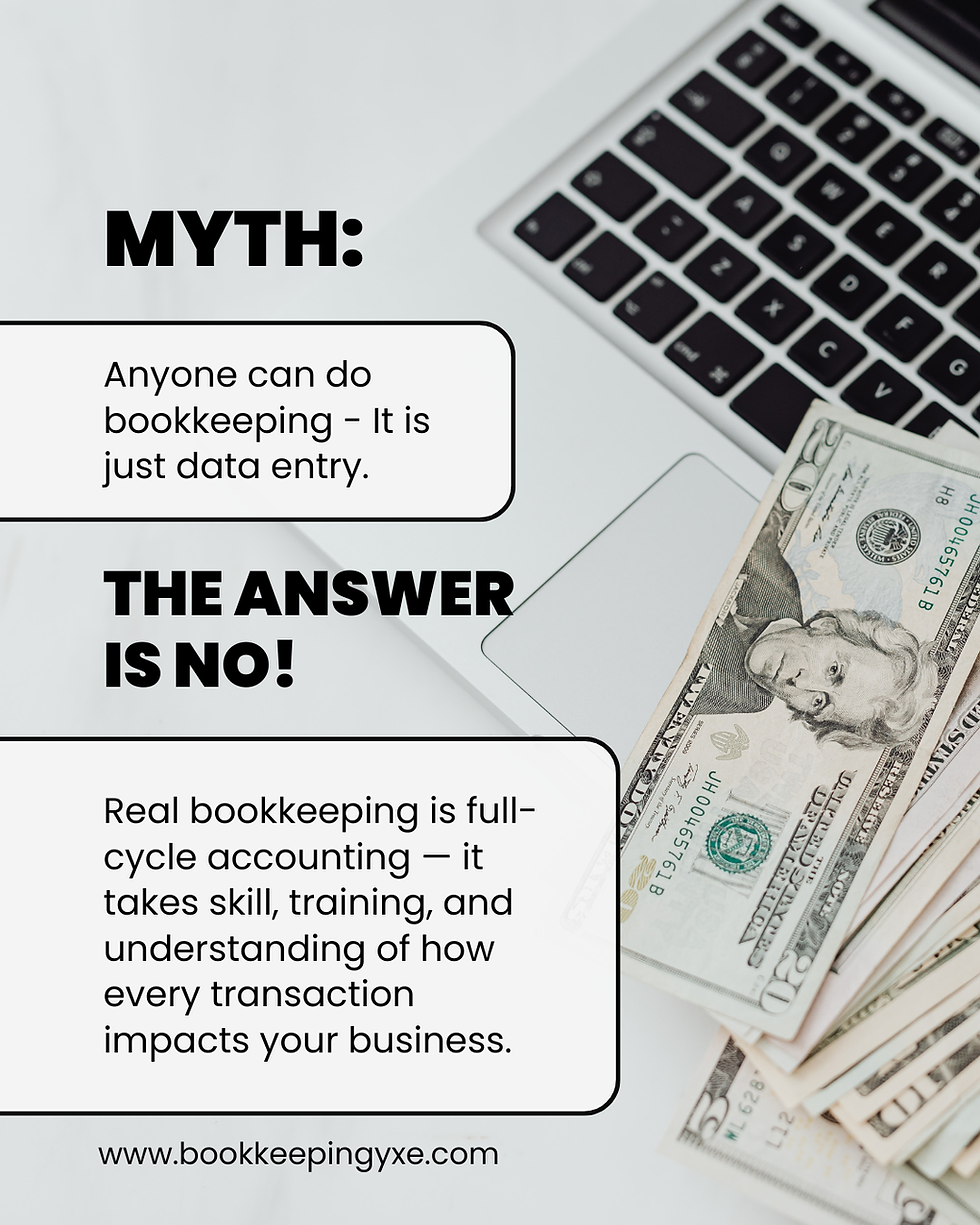
There’s a big difference between basic bookkeeping and full-cycle bookkeeping.
Basic bookkeeping covers the simple stuff — recording transactions, organizing receipts, and maybe reconciling a bank account. While this keeps your books somewhat organized, it doesn’t ensure accuracy or compliance.
Full-cycle bookkeeping, on the other hand, involves:
Managing the entire accounting process from start to finish (sales, purchases, payroll, adjustments, and reporting).
Reconciling not just bank accounts, but credit cards, loans, and tax accounts.
Understanding how transactions flow through the general ledger and affect your financial statements.
Preparing accurate financial reports that show your real profitability and cash flow.
Working with accountants to ensure your books are tax-ready and CRA-compliant.
A professional bookkeeper understands accounting principles, not just software clicks. They can spot errors, identify red flags, and make sure your business financials truly reflect what’s happening — not just what’s entered.
Find yourself a bookkeeper who is humble enough to take criticism, mistakes, huge learning curves and turn them into experiences they grow in their knowledge and implement in their practice.
Invest in your business. Stay on top of things. Relieve stress. Focus on your growth.


Comments